空間美術館はとても小さな美術館です。4つの展示室とラウンジから構成されており、中規模の作品が3部屋。小さな作品が7点あります。さっと理解するだけなら、10分程で一通りまわってしまうこともできます。しかし、ずっと眺めていても飽きない作品や、いろんな角度から見たり、動きながら見てはじめてわかる作品があり、1時間では足りないというお客様もいらっしゃいます。ある意味、見る力が試される美術館といえるかもしれません。ぱっと見て分かる親切な作品はありませんが、作品を介して新しい感覚が自分の中に芽生え、何かを感じた時、知覚が一つ増えるような豊かさが待っています。忙しい日常を離れて、ゆっくりと時を過ごす体験をしていただけたらと思います。
Analemma
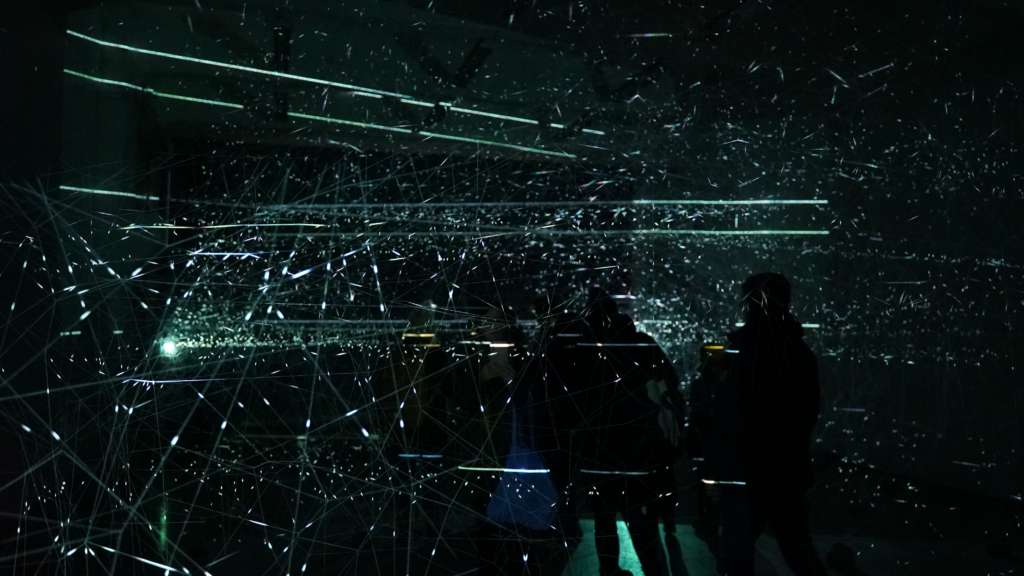
目に見えず触れることのできない「空間」が美しさと関係しているのではないか。かつて画家たちは、科学的な手法、あるいは自身の感性に頼り、二次元の平面に「空間」を表現する工夫を重ねてきました。建物の中であれ自然の中であれ、空間が身体に与える影響を感じた経験は、誰にでもあることでしょう。
では「空間」とは一体何でしょうか。三次元空間における位置座標はベクトルやスカラー量で表すことができますが、それは美しさを内包する空間と同じものでしょうか。ダンサーやアスリートが身体を通して捉える空間とは、どのようなものでしょうか。あらゆるものは三次元空間に存在していますが、私たちは空間そのものを知覚することはできません。この作品では、低密度の素材を空間に充満させ、空間を「知覚可能な存在」として、美しさや空間そのものを顕現させようと試みたものです。
タイトルの「アナレンマ(Analemma)」とは、太陽からの光線(一次元の線)と写真フィルム(二次元の面)が交差する場所に現れる天文現象のことです。この作品では、糸(一次元の線)とプロジェクターから投射された光の面(二次元の面)が交差する場所に、現象が現れます。この一次元と二次元の関係性がAnalemmaと同じことからタイトルがつけられました。また、視覚的な類似性に基づいた直接的なタイトルをつけないことで、作品とタイトルの間にも空間(余白)があります。
Could it be that “space”—something invisible and intangible—is linked to beauty? Throughout history, painters have employed scientific methods or relied on their own sensibilities to devise ways of representing “space” on two-dimensional surfaces. Whether within a building or amidst nature, everyone has likely experienced the impact that space can have on the human body.
But what, exactly, is “space”? While positional coordinates in three-dimensional space can be expressed through vectors or scalars, is this the same kind of space that embodies beauty? How do dancers or athletes perceive space through their bodies? Although everything exists within three-dimensional space, we cannot perceive space itself. In this work, I have filled the area with low-density material, attempting to manifest space—and the beauty inherent in it—as a “perceivable entity.”
The title “Analemma” refers to an astronomical phenomenon that emerges where rays of sunlight (one-dimensional lines) intersect with photographic film (a two-dimensional plane). In this artwork, a similar phenomenon appears where threads (one-dimensional lines) intersect with planes of light projected from a projector (two-dimensional surfaces). The title was chosen because this relationship between the one-dimensional and the two-dimensional mirrors that of an analemma. Furthermore, by avoiding a title based on direct visual resemblance, a “space”—or a margin—is created between the artwork and its title.
Aftereal 2
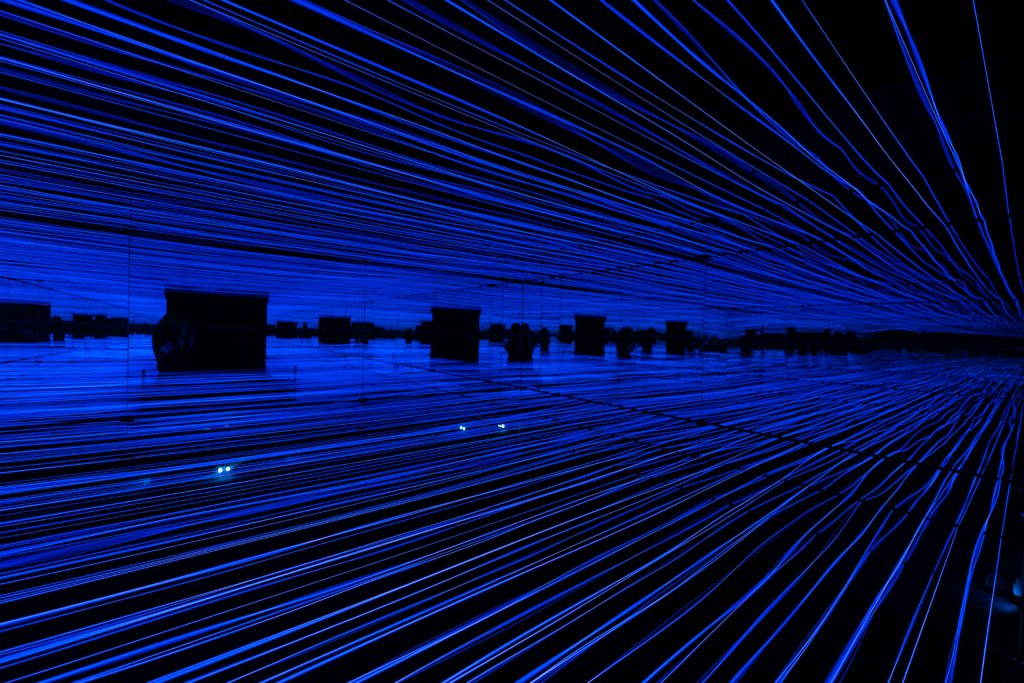
青く広がる波のようなものは、実際にはそこに存在していません。眼に見えるものは、全て私たちの網膜、または脳に残った残像です。糸は高速で振動し、紫外線に反応して青く光っています。ストロボの効果により、私たちはその残像を見ます。
私たちは常に同じセンサー、つまり目や脳を使って世界を知覚していますが、完全なセンサーはありません。世界は無限の可能性を孕んで存在し、私たちの不完全な知覚は、そのごく一部を捉えています。
北アルプスの燕岳で、眼下に雲海、頭上にも雲がたちこめ、その上下の雲の間に夕陽が落ちるのを見たことがあります。雲は夕陽に染まり、視界は赤一色になりました。その時の鮮烈な記憶がどこか作品の形態に影響を与えたのかもしれません。
The expansive, blue, wave-like forms do not actually exist there; what we see are merely afterimages lingering on our retinas or in our brains. The threads vibrate at high speed, glowing blue in response to ultraviolet light, and the stroboscopic effect allows us to perceive these afterimages.
We constantly perceive the world using the same sensors—our eyes and brains—yet no sensor is perfect. The world exists with infinite possibilities, and our imperfect perception captures only a tiny fraction of them.
I once witnessed a sunset while on Mount Tsubakuro in the Northern Alps, with a sea of clouds stretching out below and clouds gathering overhead; the sun sank into the space between them. The clouds were dyed by the setting sun, enveloping everything in a world of deep crimson. That memory may well have influenced the form of this work in some way.
Photo:Tooru Tsuji
Myrkviðr
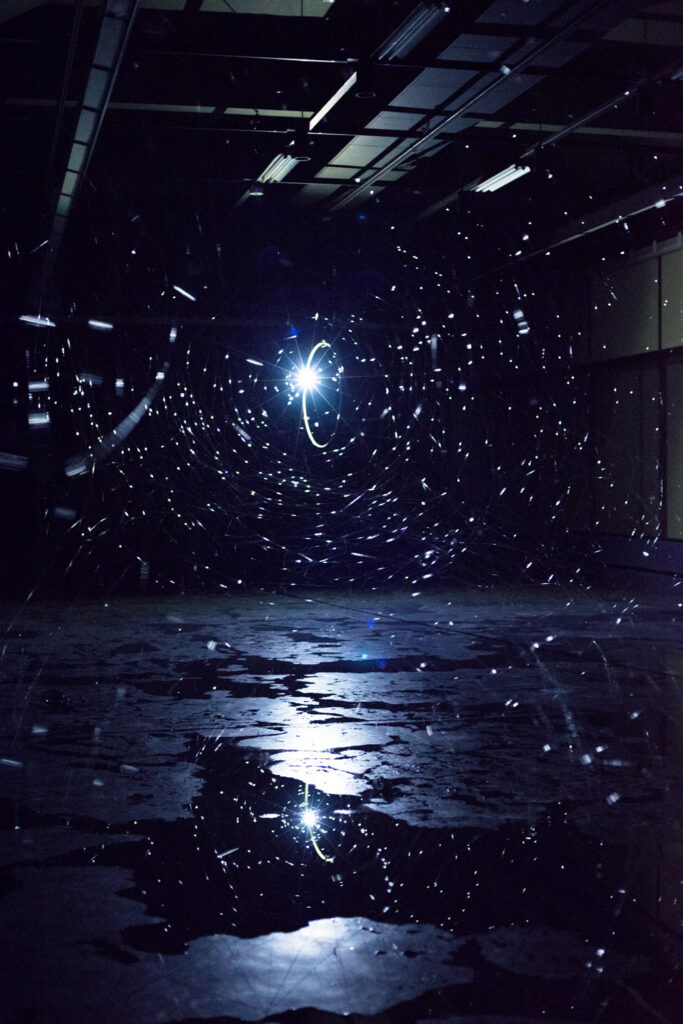
この作品は宇宙や星空を再現したものではありません。しかし、星を眺めて見飽きないのは何故でしょうか、ただの光の点にすぎないのに。
それが本当に存在し、遥かな距離があること。過去から旅をしてきた光が今届いていること。どこかに私たちのような生き物がいるかもしれないこと。宇宙が拡がり続け、そしていつか宇宙が終わること。それらの事実を含み、そこに存在するからでしょうか。
この作品に使われているのは、徹底的な手仕事、現実の物質。デジタルデータや、虚像ではありません。事実だからこそ、星を眺める時のように想いを馳せる余白が生まれるのだと思います。
世界の美しさの秘密。人の手にこそ出来る何か。
This work does not simply recreate the cosmos or a starry sky. But, why is it that we never tire of gazing at the stars, even though they are nothing more than points of light? Perhaps it is because they embody such profound realities: their actual existence across vast distances; the light reaching us now after traveling from the past; the possibility that beings like us exist somewhere out there; and the fact that the universe continues to expand—and will one day come to an end.
This piece is crafted through meticulous handwork using tangible, physical materials; it relies on neither digital data nor virtual imagery. It is precisely because it is real that it creates the space for our imaginations to wander, much like when we look up at the stars.
The secret to the beauty of the world. What only human can achieve.
Photo: Yasuhiro Takahashi
Spectrum
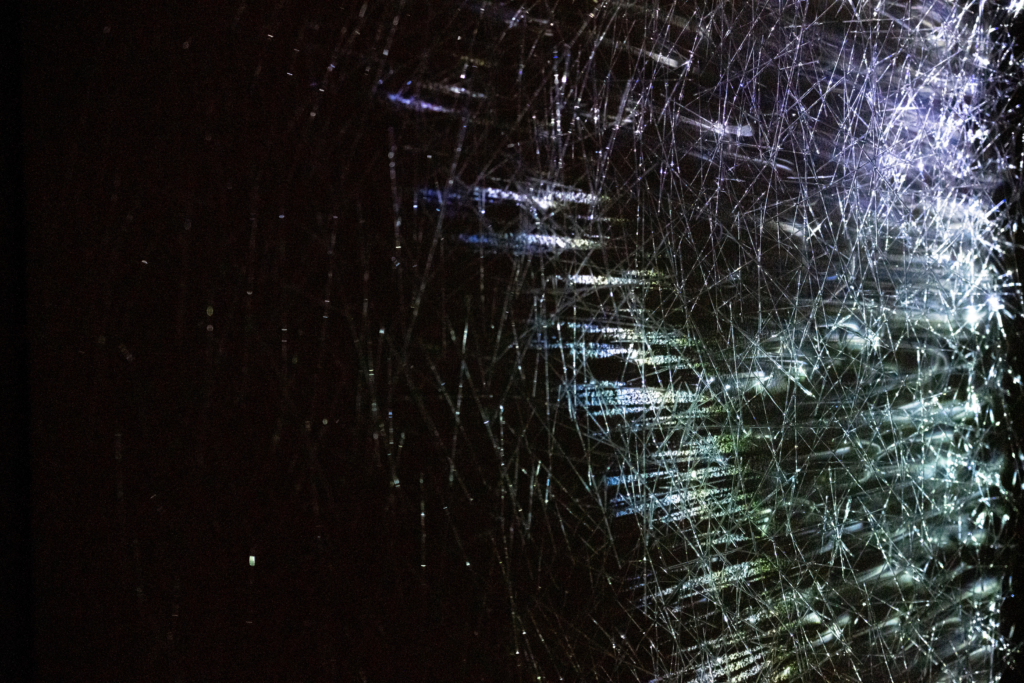
一本づつ手作業で、ひねり、伸ばされたガラスの棒が、立体的に組まれている。全て違う形に歪んだレンズとして、光を屈折させ、床や壁に模様を描く。
左から見るのと、右から見るので、見え方が変わります。
Glass rods, each twisted and stretched by hand, are assembled into a three-dimensional structure. Acting as lenses distorted into unique shapes, they refract light to cast patterns onto the floor and walls.
It looks different depending on whether you view it from the left or the right.
0.04
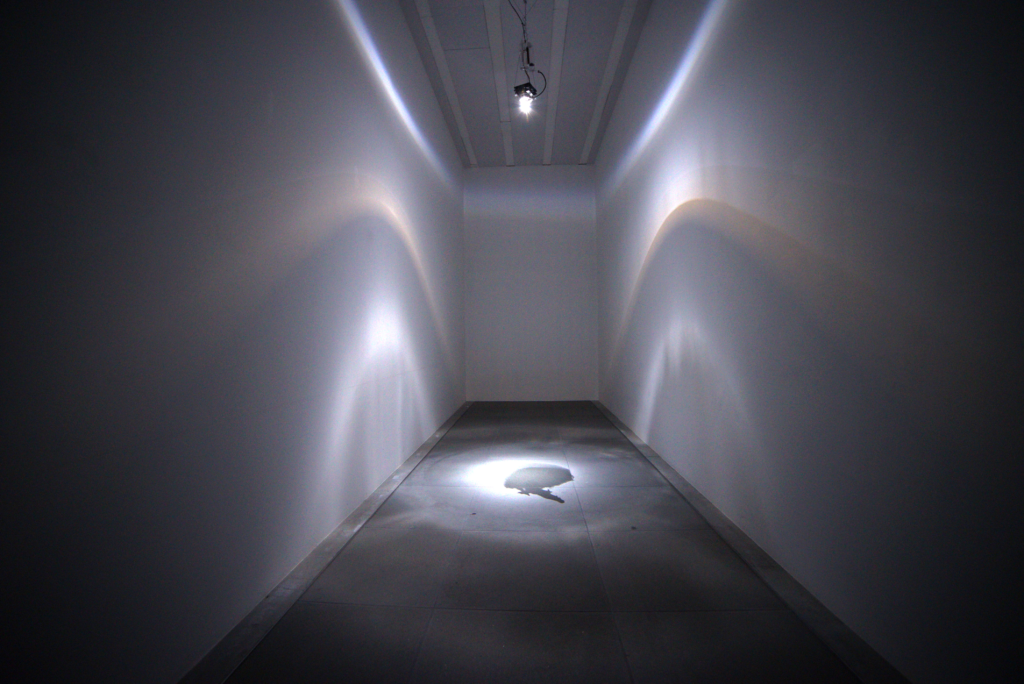
滴る水滴が、屈折率の変化し続けるレンズとなり、床や壁面に、連続的に変化する光の模様を描く。
水滴内部の微細な変化により、二度と同じ模様が現れることはない。
宇宙を構成する主要素である、光、空間、時間が、重力と水の表面張力によって繋げられる。
Dripping water droplets function as a lens with a constantly shifting refractive index, projecting patterns of light on the floor and walls that change continuously. Thanks to the minute changes inside the water droplets, the same pattern never appears twice. In this work, the relationship between the main elements that comprise the universe — light, space, and time — are connected to each other through gravity and the surface tension of water.
※画像は過去に別の会場で撮影された同じ作品の画像になります。